
After Gaza, Trump's Efforts Fail in Thailand-Cambodia Conflict
Who Can Stop The War Now?
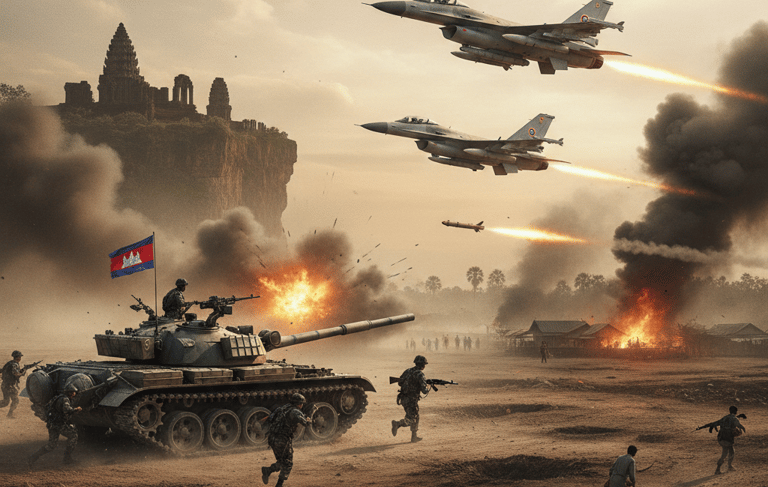
The fragile peace along the Thailand-Cambodia border, painstakingly brokered by President Donald Trump just months ago, has shattered. Much like the complex international conflicts he aimed to resolve, this centuries-old territorial feud has flared up with brutal, modern intensity, highlighting the limits of even high-stakes diplomacy when deep-seated national grievances are involved.
Cause for Conflict: The Unfinished Map and Ancient Gods
The current round of fighting is rooted in the undemarcated borderlands surrounding the ancient Hindu temples, most notably the 11th-century Preah Vihear. While the temple structure itself was awarded to Cambodia by an international court, the surrounding territory—and the two nations' competing claims to national heritage—has never been fully resolved. The latest skirmishes seem to have been sparked by a breakdown of trust, with both sides accusing the other of renewed military provocations and violating the previous truce.
The War Machine of Washington & Beijing: F-16s vs. T-55s
The conflict on the ground has demonstrated the stark contrast in the two nations’ military backing. For the last three days, the sophisticated arsenal of both armies has been deployed:
Thailand, a key U.S. partner, has launched multiple F-16 fighter jets to conduct air strikes, targeting Cambodian military positions. This showcases the modern military capacity derived from its long-standing relationship with Washington as an arms supplier.
Cambodia, which receives significant military aid and political backing from Beijing, has countered with heavy artillery and its main battle tanks, including T-55 tanks, in defensive positions and counter-attacks. This highlights China's deepening military ties and commitment to Phnom Penh's security posture.
Humanitarian Crisis and Geopolitical Fallout
Further escalating the international angle, a compound reportedly belonging to a Chinese-operated company near the border was reportedly attacked, though details of the damage are unclear. Given China's significant economic and political investment in Cambodia, an attack on Chinese assets injects an immediate layer of geopolitical risk into the conflict, putting the global rivalry between Washington and Beijing squarely on the contested border.
The Way Forward Through ASEAN, UN or the USA
The renewed conflict forces a critical look at the mechanisms available to stop the fighting.
ASEAN's Challenge: The primary regional body, the Association of Southeast Asian Nations (ASEAN), faces a severe test of its relevance. As a consensus-based organization, ASEAN has struggled historically to forcefully intervene in disputes between its own members. Its strength lies in "quiet diplomacy" and providing a forum for dialogue, but the current, high-intensity conflict requires swift, decisive action. Analysts question the bloc's capacity to mandate and enforce a robust ceasefire or a permanent monitoring mission without strong external pressure.
The UN Angle: While the previous UN-mandated International Court of Justice (ICJ) rulings settled the ownership of the temple itself, the UN's broader role is largely diplomatic and humanitarian. The UN Security Council could issue resolutions, and agencies like UNESCO are likely to express deep concern for the cultural heritage sites. However, any meaningful UN-led peacekeeping or strong political intervention would face diplomatic hurdles given the indirect involvement of the U.S. and China, both permanent Security Council members.
Trump’s Call: Meanwhile, US President Trump repeated his claim of solving many international conflicts and announced that he would be making a phone call and stop the war between Thailand and Cambodia.
Where Will It Stop? A Path to Peace
The current escalation is particularly worrying because the objectives on the ground appear to be maximalist. Thailand’s government has signalled a determined intent to assert its sovereignty over disputed areas, while Cambodia’s powerful leadership has vowed fierce retaliation to defend its territory. In such a scenario, the fighting can only cease if there is a direct, coordinated, and non-negotiable pressure from both the United States and China, who hold key leverage over their respective allies to enforce a lasting de-escalation.
As the shared history and cultural heritage of these two Southeast Asian nations offer a basis for reconciliation, the ASEAN could be roped in to mobilize an impartial mediation team, leveraging the shared fear of regional instability and economic disruption, and bring back these two countries to the negotiating table. The immediate goal must be a binding, monitored ceasefire, paving the way for definitive, internationally-supervised border demarcation. The two sides must be made to realize that the current violence is severe and the ultimate resolution of the conflict and restoration of peace can and will only come through diplomacy, nor war.