
Bangladesh Poses A Strategic Challenge For India
Pak Takes Revenge and US an Island, as China Waits
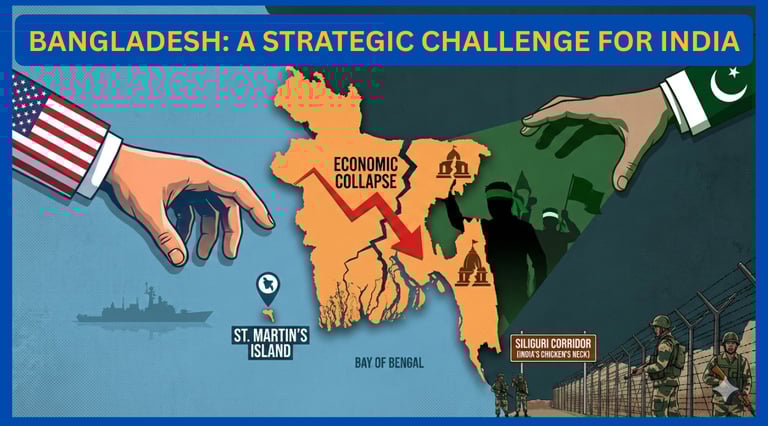
The transformation of Bangladesh from a "South Asian Tiger" to a zone of religious and social volatility is not merely an internal political shift; it represents a meticulously engineered geopolitical squeeze designed to isolate New Delhi in the region. For over a decade, Bangladesh enjoyed unprecedented economic stability and a secular alignment that anchored regional security. However, as of late 2025, with Muhammad Yunus at the helm, its progress has been derailed. The ousting of Sheikh Hasina's secular government in August 2024 has paved the way for a radicalized state, where the convergence of Pakistan’s thirst for historical revenge and the United States' strategic maritime ambitions has effectively "reset" the nation into a geopolitical proxy.
For Pakistan, the current turmoil represents the ultimate payback for the humiliation of 1971 and the surrender of 93,000 POWs. By backing the interim administration and rehabilitating radical outfits like Jamaat-e-Islami, Asim Munir's Rawalpindi is systematically erasing the secular foundations of the 1971 Liberation War. Militant organizations like Lashkar-e-Taiba (LeT) and Hizbul Mujahideen have successfully exploited the "Muslim Brotherhood" narrative to regain a foothold, turning Bangladesh into a springboard for destabilizing India’s "Seven Sisters." The goal is clear: to force India into a two-front security nightmare by weaponizing a once-friendly neighbor.
Parallel to this, the US's interests have focused on the strategic real estate of the Bay of Bengal. Sheikh Hasina’s repeated warnings about pressure to cede St. Martin’s Island for a military base appear more prophetic today than ever. In the US’s broader Indo-Pacific strategy to contain China and monitor India’s naval dominance, a "pliable" government in Dhaka is a necessity. The interim government’s swift moves toward joint military exercises and the reported presence of foreign personnel near Chittagong suggest that the "reset" was a pre-meditated exchange of sovereignty for political backing.
This geopolitical maneuvering has come at a devastating cost to the Bangladeshi people. The economic rise that saw Bangladesh surpass India in per capita GDP has hit a wall. In FY2025, GDP growth has plummeted to a meager 3.7%, while inflation rages at 12%. The Ready-Made Garment (RMG) sector, the nation's economic backbone, is suffering from mass layoffs and factory lootings. What was marketed as a "Gen-Z Revolution" has effectively ended the era of prosperity, leaving the country dependent on IMF lifelines and foreign dictates.
Socially, the country is being reshaped by a wave of religious intolerance that targets the very heart of Bengali culture. Since August 2024, more than 1,700 attacks on Hindus have been documented, involving arson, vandalism, and forced displacement. The rise of groups like the Inqilab Mancha and the recent violent protests surrounding the death of youth leader Sharif Osman Hadi on December 19, 2025, illustrate a nation spiraling into mob rule. The systematic removal of secularism from the constitution is the final blow to the pluralistic vision that once defined the country.
For India, the shifting landscape in Bangladesh represents a multi-front strategic challenge. The emerging US-Pakistan nexus in Dhaka poses a direct threat to India’s Siliguri Corridor (the "Chicken’s Neck"), as a pro-Pakistan military and intelligence apparatus, now featuring a revived ISI presence, could transform Bangladesh into a sanctuary for radical groups like Lashkar-e-Taiba and Hizbul Mujahideen. By exploiting an "Islamist Brotherhood" narrative, this alliance threatens to destabilize India’s Northeast through a "third front" of cross-border insurgency and a "Greater Bangladesh" ideological expansion.
Meanwhile, China’s calculated silence over increasing US influence is a masterclass in strategic reticence. Beijing is content to let US-India tensions simmer while it quietly secures the Mongla Port and signs billion-dollar defense deals for J-10 fighter jets. To counter this, India’s options range from hard-power posturing such as the rapid fortification of the Dhubri Garrison to economic coercion, including the suspension of transshipment privileges and the selective use of trade levers. Ultimately, New Delhi must bypass the Dhaka-Islamabad-Beijing trilateral by doubling down on BIMSTEC and asserting clear, non-negotiable red lines on regional sovereignty.