
Can US Break the Moscow-Beijing-Caracas Axis in Venezuela?
Row Intensifies as Maduro Hits Back At Trump's Ultimatum
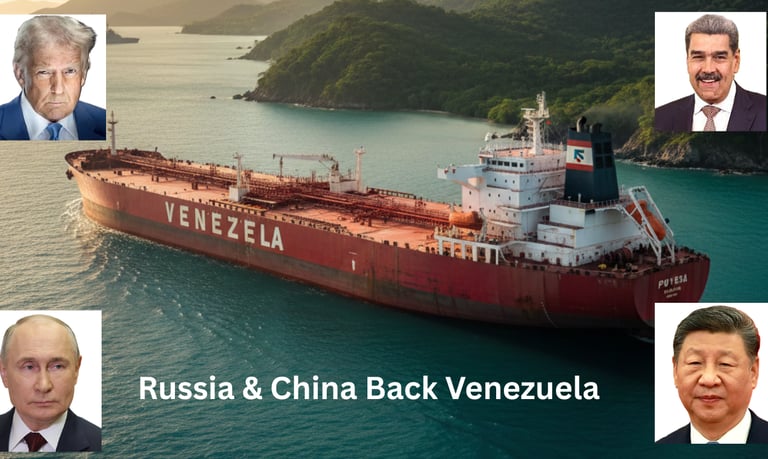
The Caribbean has become the focal point of a 21st-century "Monroe Doctrine" showdown, as the United States and Venezuela are on the brink of all-out war. President Trump’s recent declaration of a "total and complete blockade" and his demands for the return of "stolen oil and land" have brought the two nations to their most volatile point in history. This transactional shift, framing the dispute as a debt-collection mission for billions in expropriated assets from the 2007 nationalization wave, has been backed by the deployment of the USS Gerald R. Ford and the killing of over 100 people in maritime strikes. Yet, despite the "largest Armada ever assembled", US has not been able to wage a full-scale invasion of Venezuela.
The reason for US not venturing a full-scale war against Venezuela appears to be a complex "Steel Umbrella" provided by Moscow. Russia has effectively turned Venezuela into its primary military bridgehead in the Western Hemisphere, deploying over 5,000 Igla-S anti-aircraft missiles and maintaining advanced S-300VM long-range systems. These Russian-made defenses are designed to make any US "surgical strike" or helicopter-borne operation incredibly costly. Moscow has explicitly warned Washington against making a "fatal mistake," signaling that any move against Caracas is a move against a core Russian ally. For Putin, Venezuela is a vital strategic outpost that forces the US to divert military attention away from Eastern Europe to its own southern border.
Complementing Russia’s steel umbrella further is China that provides the economic "shield" to Venezuela. As the primary destination for over 85% of Venezuelan oil exports, Beijing has slammed the US blockade as "unilateral bullying" and a violation of international law. In recent emergency sessions at the UN Security Council, Chinese envoys warned that the US campaign of "seizing oil tankers and shooting crew members" threatens peace and security in Latin America. By maintaining an "all-weather strategic partnership", China ensures that the Maduro regime has the cash flow to sustain military loyalty, even as Trump threatens a 25% tariff on any country, including China that continues to import Venezuelan crude.
Faced with this dual-power backing, Trump is currently navigating a menu of escalating options. His primary tool is the "quarantine"—a term intentionally evocative of the 1962 Cuban Missile Crisis, designed to exert "maximum economic pressure" without the messiness of a ground war. This involves the US Coast Guard and Navy intercepting and seizing tankers, such as the M/T Skipper, to starve the regime of its revenue. While "military options remain on the table," the White House has reportedly ordered the military to focus almost exclusively on this blockade in the short term, hoping to trigger a collapse from within the Caracas elite.
The pressure is also being applied through "personal warfare." The recent awarding of the Nobel Peace Prize to opposition leader María Corina Machado has provided the US with a moral mandate to justify its intervention as a defense of democratic struggle. Simultaneously, the US Treasury has tightened the noose by sanctioning the immediate family of Maduro’s wife, Cilia Flores. This strategy aims to fracture the regime's inner circle by proving that even the most loyal supporters can no longer protect their assets or families from the reach of the US financial system.
However, Trump continues to hesitate on an all-out war for pragmatic reasons. Analysts point out that the 15,000 troops currently deployed by US are insufficient for a full-scale invasion of a country with 30 million people and a 4-million-strong civilian militia. Such an operation would require a massive commitment of hundreds of thousands of troops, risking a "South American quagmire." For a president who campaigned on ending "endless wars" and prioritizing "pro-worker prosperity," a bloody jungle war would be a hard sell to the American public, especially with the 2026 mid-terms on the horizon.
Ultimately, Trump is constrained by the limited options available to the US and the reality that an all-out war would be very costly in both blood and treasure. He cannot risk starting a "fire in his own backyard" that could spiral out of control and destabilize the entire hemisphere. A massive ground conflict would trigger an unprecedented refugee crisis, sending millions of migrants toward the US border and directly contradicting his core domestic priority of border security. Furthermore, a kinetic exchange involving Russian advisors or Chinese assets could escalate into a direct confrontation with nuclear-armed rivals, a risk far beyond the value of the assets in question. Faced with these dangers, Trump has pivoted toward "controlled escalation", using naval blockades and targeted strikes on alleged drug boats to force a surrender while avoiding the catastrophic regional fallout and the astronomical expense of a total war.