
Can US-Japan Deterrence Hold Against China-Russia Alliance over Taiwan?
Global Powers Brace for Impact as the 2027 Invasion Deadline Nears
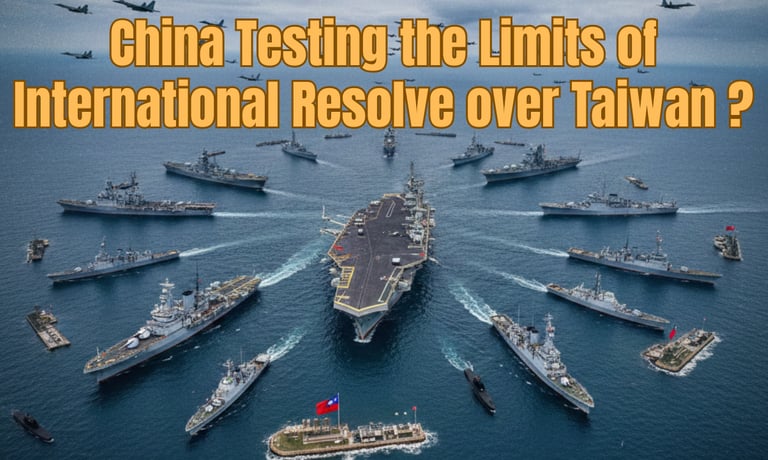
As of January 2, 2026, the Taiwan Strait has reached a critical boiling point. Following the Trump administration’s approval of a landmark $11.1 billion arms contract, Beijing recently concluded "Justice Mission 2025," a massive military exercise that effectively encircled the island with a "joint blockade" simulation. Utilizing aircraft carriers, destroyers, and rocket forces to choke off major ports, these maneuvers represent one of the most aggressive displays of force in recent history. The international community is now forced to ask whether this is merely a rehearsal or the final prelude to a conflict that has been decades in the making.
This escalation is deeply tied to Beijing’s strategic policy to achieve military readiness for a Taiwan takeover by 2027. This date, often called the "Davidson Window," marks the 100th anniversary of the People’s Liberation Army (PLA). President Xi Jinping has reportedly instructed his forces to be capable of a successful invasion by this deadline. The recent encirclement drills appears to be less about immediate war and more about a "stress test" to see if the PLA can meet that 2027 goal, while measuring the speed and cohesion of the global response in the actual war situation.
At its heart, the standoff remains a stark ideological battleground: Taiwan’s vibrant democracy versus the Chinese Communist Party’s (CCP) authoritarianism. For Taipei, the struggle is about preserving a way of life that values free speech, open elections, and the rule of law. Conversely, the CCP views Taiwan’s autonomy as the last remaining obstacle to its "national rejuvenation". This clash of systems means that for Taiwan, any concession isn't just a political move - it’s an existential threat to the democratic identity they have built over several generations.
In response to the looming threat, Taiwan has moved beyond traditional military preparation to embrace an "all-out defense" model. Throughout 2025 and into early 2026, the island conducted its most realistic civil and military drills to date. Integrating the Han Kuang war games with Wanan air-raid exercises, the government has begun training about 22,000 reservists and testing "urban resilience." For the first time, civilians in major cities like Taipei have been seen participating in large-scale evacuation drills and medical response simulations, preparing for the reality of urban warfare and potential commando raids on critical infrastructure.
The United States has countered Beijing’s aggression with a series of stern warnings and massive hardware transfers. While President Trump has at times used measured rhetoric, noting that these drills have happened for "20 years", the State Department recently condemned the encirclement as "highly provocative" and "unnecessarily escalatory". The record-breaking arms package, which includes HIMARS and advanced drone swarms, is intended to turn Taiwan into a "porcupine" that is too painful for China to swallow, signaling that the US is closing the window of opportunity for a low-cost invasion.
Lately, China’s confidence is also bolstered by its "no-limits" partnership with Russia. Some reports indicate that Moscow is actively sharing military technology and training Chinese paratroopers in high-altitude drops. Xi Jinping see this pact with a sense of strategic depth, ensuring a steady supply of energy and raw materials should a Western blockade be imposed. However, the reality of Russian support to China in a war is complicated by the fact that the Kremlin is already in its own war with Ukraine and there are indications of it expanding for creating new "buffer zones" in regions like Sumy and Kharkiv. With its own military-industrial base strained, Russia’s ability to offer physical military assistance to China in a Taiwan conflict would be severely limited.
Ultimately, the question of deterrence remains unanswered, especially as Japan emerges as a critical third pillar of defense for Taiwan. Under Prime Minister Sanae Takaichi, Tokyo has explicitly stated that a "Taiwan contingency is a Japan contingency," legally designating such a conflict as a "survival-threatening situation" for Japan that could trigger its own Self-Defense Forces. This shift, combined with US intervention, and Russian strategic support, significantly increases the chances of a local flashpoint escalating into a catastrophic international war. As the encirclement continues, the world remains on a razor's edge, watching to see if the 2027 deadline becomes a point of no return for a global conflict.