
How Far is China Right in Blaming the US for its Souring Ties with India?
Decoding Beijing’s Push to Win Back India's Trust & Its Market
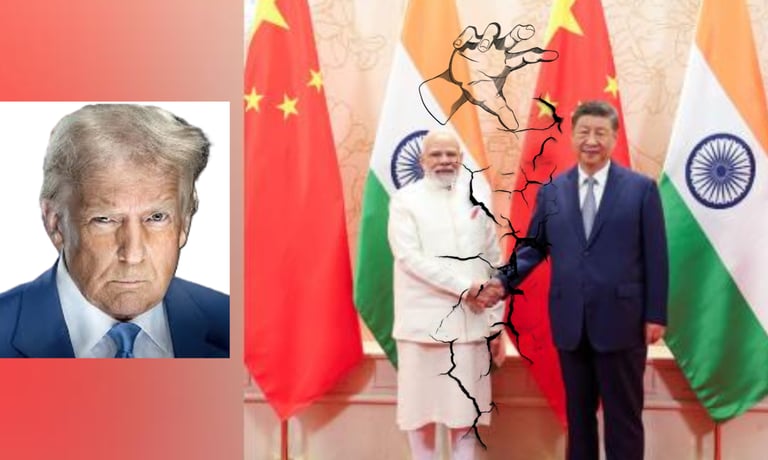
The intricate dance of geopolitics in Asia often resembles a high-stakes chess match, with each move calculated to gain an advantage. Recently, Beijing has sharpened its rhetoric, "calling out" the United States for stoking tensions between India and China. But beneath this blame game lies a complex web of historical grievances, military alliances, and economic realities. To understand China's play, we first need to look at how these relationships have evolved.
For decades, China and India have shared a relationship defined by a fragile balance between cooperation and friction. From the "Hindi-Chini bhai-bhai" optimism of the 1950s to the scars of the 1962 border war and the 2020 Galwan Valley clashes, the two giants have struggled to reconcile their overlapping ambitions. While trade surged for years, the unresolved border remains a "live" issue, complicated further by China’s expansionist policies and its continued military support to Pakistan. China's expansionist claims in India center on territorial disputes along the Line of Actual Control (LAC), particularly claiming India's Arunachal Pradesh (calling it "Southern Tibet") and occupying parts of Ladakh like Aksai Chin, leading to frequent border clashes. By providing Islamabad with advanced fighter jets, submarines, and nuclear technology, Beijing has effectively forced India into a permanent "two-front" defensive posture, ensuring that New Delhi remains bogged down in regional security concerns.
In contrast, US-India relations have moved from Cold War-era wariness to a robust strategic partnership. Driven by a shared vision of a "Free and Open Indo-Pacific", Washington and New Delhi have tightened their bond through defense deals and the Quad alliance. For India, the US is a critical partner in modernizing its military and diversifying its technology, while for the US, India is the essential democratic counterweight to an assertive China in Southeast Asia region. This deepening axis is exactly what Beijing is now trying to dismantle by branding the US as an "external meddler" that profits from Asian instability.
China’s current blame on the US serves a specific strategic purpose: it seeks to frame the border dispute as a bilateral issue that "outside powers" are exploiting. By accusing Washington of "sowing discord," Beijing hopes to trigger India’s traditional sense of strategic autonomy, making New Delhi hesitate to align too closely with the West. In a way, China is trying to convince India that it is merely a "pawn" in an American containment strategy, in a bid to drive a wedge between the two, leaving India to face the Dragon's regional influence without its superpower partner.
Beyond security, there is a massive economic angle to this tension. China is increasingly anxious about losing out on the big, upcoming market in India for its factories. For years, Chinese electronics, solar panels, and machinery dominated Indian shelves. However, following the border clashes, India has tightened the screws with stricter FDI rules, import restrictions and "Make in India" initiatives. As Western firms move their supply chains out of China, Beijing fears that its neighbor will not only stop buying its goods but will eventually replace China as the world’s manufacturing hub.
China is also banking on the fact that US-India Trade Talks remain frozen because of US insisting India to open its agriculture and diary markets, and US imposing 50% tariff on India for buying Russian oil. The stakes reached a fever pitch following the recent SCO summit in China, where images of Prime Minister Modi and President Xi sharing a cordial, high-profile meeting went viral. The optics of this "thaw" triggered an explosive reaction from Washington. President Trump, frustrated by India’s refusal to buckle under his 50% "reciprocal tariffs" and its continued purchase of Russian oil, took to social media to declare, "We have lost India to deepest, darkest China," while sarcastically wishing them a prosperous future together.
India’s response to such statements has been a firm display of "de-hyphenated" diplomacy. New Delhi has made it clear that while it is open to de-escalating border tensions, as seen in the recent patrolling agreements and the 2025 Tianjin summit, it will not compromise on its sovereign right to choose its partners. Indian officials have essentially told Beijing that if it wants better relations, it must address the "trust deficit" caused by border incursions and the military emboldening of Pakistan, rather than blaming third parties in Washington or other capitals.
Ultimately, this geopolitical drama highlights a continent in transition, where every diplomatic statement is a move for leverage. China gains if it can "reset" ties just enough to get its products back into Indian markets, while the US fears any sign of Asian rapprochement as a loss of influence. It is a world of shifting loyalties and hardened interests, with the United States playing its game of global hegemony, China playing its game of regional dominance, and India playing its game of strategic independence.