
India’s Rise as a Global Tech Superpower
Leading the AI and Chip Revolution
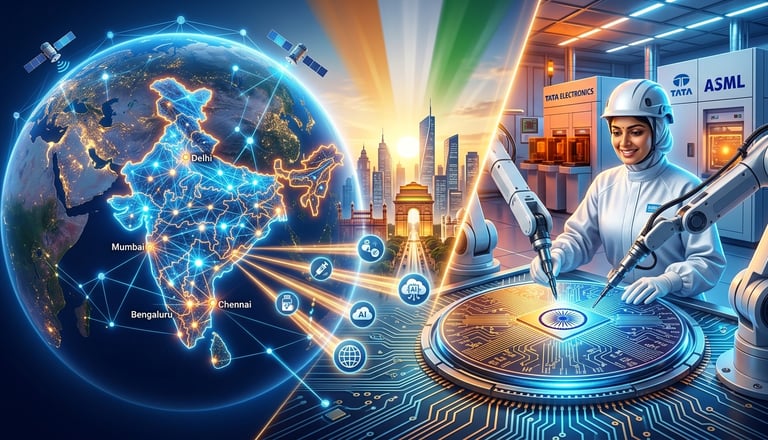

The global technology landscape is undergoing a historic realignment, and India is no longer operating from the sidelines. The country’s technology ecosystem has decisively evolved beyond its traditional back-office IT identity into a high-value deep-tech powerhouse with growing influence over the future of artificial intelligence, semiconductor manufacturing, and digital infrastructure.
Moving beyond short-term domestic headlines, India has already surpassed several major Western economies in its contribution to global economic growth. That same momentum is now accelerating the country’s emergence as one of the world’s leading AI ecosystems, positioning India alongside the United States and China as a major force shaping the next technological era.
But India’s rise is not simply about scale or market size. It reflects the construction of a complete AI ecosystem, where multiple foundational pillars are advancing together in a coordinated national strategy.
A true AI ecosystem is built on four critical layers:
A strong talent and research base capable of designing advanced models and systems
Massive data enablement for training and deploying AI at scale
Robust computational infrastructure powered by GPUs, cloud systems, and digital connectivity
A progressive regulatory and policy framework that enables rapid but secure innovation
Fortunately, India has been advancing aggressively across all four fronts.
The country now possesses the world’s second-largest pool of AI engineers and developers. Leveraging its enormous population scale and multilingual diversity, India is focusing on building sovereign AI systems and affordable language models designed specifically for regional realities rather than imported assumptions.
At the heart of this push lies India’s Digital Public Infrastructure (DPI), which has already transformed digital payments, identity verification, and public service delivery at planetary scale. Combined with rapidly expanding internet penetration and smartphone adoption, this foundation has enabled India to become home to nearly 20% of the world’s AI users.
Unlike many technology superpowers that tightly gatekeep advanced infrastructure and frameworks, India’s approach signals a different philosophy for global technological progress. Rooted in the ancient civilizational ethos of Vasudhaiva Kutumbakam — “the world is one family” — India is increasingly positioning itself as a nation that intends to democratize access to emerging technologies rather than monopolize them.
Building India’s Sovereign AI Infrastructure
This philosophy is now taking concrete shape through India’s rapidly expanding sovereign AI infrastructure. Under the IndiaAI Mission, the government has already operationalized more than 38,000 high-end GPUs to support AI research, startups, and domestic model development. Another 20,000 GPUs are currently being deployed, with plans to cross 100,000 GPUs by the end of 2026. Long-term projections indicate India could invest nearly US$23 billion to build a compute base of approximately 700,000 GPUs by 2030.
Crucially, India is not reserving this infrastructure exclusively for large corporations. Through centralized national portals, startups, researchers, and developers can access advanced Nvidia and Intel compute clusters at highly subsidized costs of roughly US$0.80 per hour. This dramatically lowers the barrier to entry for innovation and prevents AI capabilities from becoming concentrated in the hands of only a few dominant players.
In effect, India is attempting to treat AI infrastructure as a public utility rather than an elite privilege. Local innovators are already beginning to capitalize on this ecosystem. Companies such as Sarvam AI are developing sovereign large language models optimized for Indian languages and regional contexts, laying the groundwork for AI systems that are culturally native, economically scalable, and globally relevant.
The Semiconductor Imperative
Behind India’s deep-tech acceleration lies another critical national objective: reducing dependence on imported semiconductors. Between 2017 and 2025, India spent nearly US$150 billion importing semiconductor components to meet domestic demand. If left unchecked, that annual import burden could explode to nearly US$240 billion by 2035, creating one of the largest foreign exchange drains in the country’s economic history.
To counter this vulnerability, the upgraded India Semiconductor Mission (ISM) 2.0 is driving an aggressive localization strategy aimed at saving between US$20 billion and US$25 billion annually through domestic chip manufacturing. Rather than immediately attempting to compete in ultra-advanced sub-5nm fabrication, India has adopted a far more pragmatic industrial strategy. The country is prioritizing mature semiconductor nodes ranging from 28nm to 110nm, which power the overwhelming majority of real-world industrial systems including automobiles, defense electronics, telecommunications infrastructure, industrial automation, consumer appliances, and electric vehicles.
This approach allows India to rapidly build manufacturing expertise, strengthen supply chain resilience, reduce imports, and generate economic returns without prematurely entering the most capital-intensive layers of semiconductor fabrication.
Building the Foundations of a Manufacturing Superpower
The results are already becoming visible. India has attracted more than ₹1.64 lakh crore (over US$20 billion) in active deep-tech and semiconductor investments across multiple states. Tata Electronics recently signed a landmark partnership with Dutch lithography giant ASML to support its upcoming US$11 billion semiconductor fabrication facility in Dholera, Gujarat.
Simultaneously, advanced packaging and semiconductor assembly plants are being developed across regions such as Assam and other emerging industrial corridors, expanding India’s manufacturing footprint beyond traditional metro hubs.
India is also becoming increasingly central to the global semiconductor talent pipeline. Nearly 20% of the world’s chip design workforce now operates from India, while approximately 30% of all new Global Capability Centers (GCCs) entering the country are directly linked to semiconductor and deep-tech operations.
A Different Model for Global Technological Leadership
India’s rise carries implications far beyond economics. At a time when global supply chains are increasingly vulnerable to geopolitical tensions and technological monopolies, India is positioning itself as a democratic, scalable, and collaborative alternative within the emerging global tech order.
Yet perhaps the most distinctive aspect of India’s ascent is the philosophy underpinning it. During the COVID-19 pandemic, India’s Vaccine Maitri initiative supplied nearly 300 million vaccine doses to over 100 countries, including millions distributed free of cost to developing nations. The country now appears determined to replicate that same model in the digital sphere.
By building low-cost AI systems, open-source frameworks, affordable compute infrastructure, and scalable semiconductor manufacturing, India is creating the possibility of a more inclusive technological future for the Global South. Rather than allowing the next industrial revolution to remain concentrated within a handful of wealthy nations, India is increasingly positioning itself as a bridge between advanced technology and developing economies that risk being left behind.
The Larger Vision: Security, Prosperity, and Shared Progress
India’s deep-tech transformation represents far more than an economic policy shift. It is a long-term national strategy that combines technological sovereignty, economic resilience, defense security, and global cooperation.
By investing heavily in AI and semiconductor ecosystems, India is working to permanently reduce its dependence on foreign technology imports while protecting itself against geopolitical vulnerabilities. Domestic manufacturing of chips, sensors, microcontrollers, and defense electronics also strengthens national security by reducing reliance on external suppliers for critical military infrastructure.
At the same time, India is consciously rejecting the purely protectionist model often associated with technological superpowers. Instead of building walls around innovation, the country is attempting to create scalable and affordable technological ecosystems that can be shared across the developing world. If successful, India’s rise could fundamentally reshape the future of global AI and semiconductor development, ensuring that advanced technology is not controlled by a small handful of monopolistic powers but distributed more equitably across nations.
In many ways, India’s emergence as a deep-tech superpower may ultimately become one of the defining geopolitical and technological shifts of the 21st century.