
Modi's Silence Strategy Pays Off: India Signs Mother of All Deals with EU
How Quiet Diplomacy Outplayed Washington’s Loud Trade Rhetoric
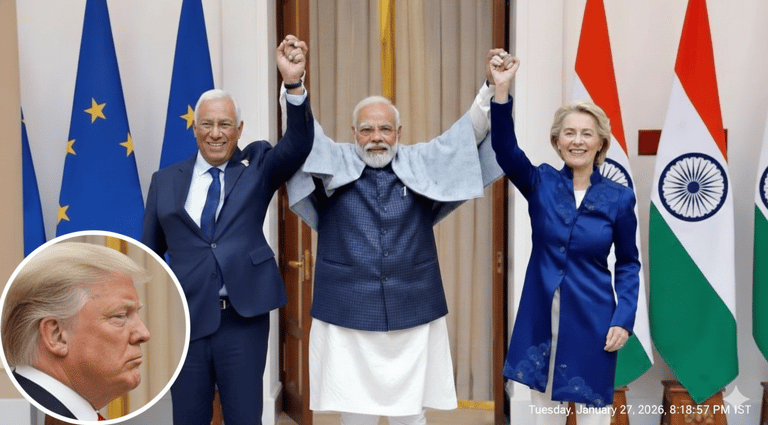
The signing of the India-European Union Free Trade Agreement (FTA) on January 26, 2026 - celebrated on India’s Republic Day as the "Mother of All Deals" - marks the dawn of a new multipolar reality. By uniting a market of over 2 billion people and nearly 25% of global GDP, this pact transcends mere commerce; it is a geopolitical masterstroke. While Washington’s "America First" doctrine became increasingly erratic, New Delhi and Brussels chose to anchor their futures in a stable, rules-based partnership. The deal effectively removes barriers for 97% of traded goods, signaling that the world's largest democratic bloc of 27 member states and the fastest-growing economy no longer require a capricious Western middleman to dictate the terms of global trade.
The "Silence Strategy": Modi’s Trump-Card
The turning point for this deal was what many are now calling Prime Minister Modi’s "Silence Strategy". Following the 2024 US election, the Trump Administration expected the usual flurry of diplomatic courting. Instead, New Delhi maintained a calculated, dignified silence in the face of escalating rhetoric. US Commerce Secretary Howard Lutnick attempted to bait India, famously claiming that the country had "missed the train" on a US trade deal because Modi failed to call President Trump within a specific three-week window. Lutnick’s dismissive comment that India was on the "wrong side of the see-saw" was intended to trigger desperation; instead, it served as a “stop, think and pivot” moment for India. By refusing to engage in "telephone diplomacy" under duress, India signaled that its sovereign interests were not for sale at the price of a phone call.
The 50% Tariff Wall and US Grievances
While the US demanded loyalty, its economic actions told a different story. The Trump Administration erected a 50% tariff wall on critical Indian exports, including steel and textiles, citing India's refusal to abandon its strategic autonomy regarding Russian energy. A similarly uncompromising narrative was adopted toward the EU, replacing decades of diplomatic nuance with a zero-sum confrontation that left little room for cooperation. US Treasury Secretary Scott Bessent voiced the administration's frustration, stating, "The United States has made enormous sacrifices for the European Union’s security for decades", only to be met with trade barriers. He issued a blunt warning that by refusing to align with US protectionism, "the EU will be financing a war against itself". This whimsical attitude, treating allies as debtors and trade as a weapon, convinced both New Delhi and Brussels that Washington was no longer a reliable guarantor of stability.
India’s Global FTA Blitz
While the US looked inward, India went on a record-breaking diplomatic offensive, signing or upgrading a flurry of FTAs in the last twelve months. This spree included a comprehensive deal with the United Kingdom, an upgraded agreement with Australia, and groundbreaking pacts with New Zealand, Oman, and a “curtain raiser” with UAE just a week back. By the time the EU reached the final stages of negotiation, India had already demonstrated its "deal-making muscle" across the globe. This established a pattern of "India as the reliable alternative," making the EU realize that if they did not secure the "Mother of All Deals," they would be the ones left standing at the station while the Indian trade locomotive moved on toward the rest of the world.
Rejecting "Vassalization" and the "Mafia Shakedown"
The European response was fueled by a desire to avoid what President Emmanuel Macron called the "vassalization" of the continent. At the 2026 Davos summit, Macron was scathing: "We prefer respect to bullies... we prefer rule of law to brutality". The sentiment was even more direct in Eastern Europe. Polish Prime Minister Donald Tusk, fresh from signing Poland's own bilateral strategic pact with India, characterized US trade demands as a "Mafia-style shakedown" where security was used as a lever to force economic surrender. Belgian Prime Minister Alexander De Croo added the finishing touch, noting that the EU must show its own "muscle" and that the United States was "not the only place in the world" for growth.
The Mechanics of the "Mother of All Deals"
The actual deal is a masterpiece of modern economic integration, designed to be "Trump-proof":
Tariff Slashes: Immediate elimination of duties on European machinery, spirits, and luxury cars (dropping from 110% to 40% as a baseline).
Mobility & Services: A revolutionary "Mobility Chapter" granting Indian professionals 90-day visa-free entry for business and ICT-related work across the EU.
Green Corridor: A €500 million joint investment fund for Green Hydrogen and semiconductor supply chains, explicitly designed to "de-risk" from both Chinese manufacturing and American tech monopolies.
Data Sovereignty: A unique framework allowing for data flows that respect both EU privacy standards and Indian data localization laws.
The Multi-Alignment Masterstroke: Stability Over Stagnation
The finalization of the "Mother of All Deals" is far more than a trade win; it is a clinical masterclass in geopolitical de-risking. By choosing strategic silence over reactionary rhetoric, PM Modi demonstrated that India’s economic gravity is no longer a card to be played in Washington’s "rigged games".
The resulting pact fundamentally realigns the global order, replacing the old "security-for-submission" model with a New Delhi-Brussels Axis built on mutual economic necessity. It proves that the world’s "middle powers" are no longer just spectators in a G2 tug-of-war; they are now the architects of a self-sustaining ecosystem that prioritizes reliable respect over transactional "sacrifices" and unilateral “insults”.
The Lessons of Whimsy: What Other Nations Must Learn
For nations watching from the sidelines, the message is clear: in a volatile world, diversification is the only credible defense of sovereignty. In a world where the US approach is increasingly dictated by the personal whims of leadership and "shakedown" diplomacy, the India-EU deal serves as a survival guide. Every other nation - from Japan to Brazil - should learn that the best defense against a whimsical superpower is a strong offense in the form of regional and bilateral alliances. The era of a single nation acting as the world’s "Board of Peace" or its sole economic engine is over. As India and the EU have shown, when one partner treats an alliance as a burden, it is time for the rest of the world to build a better partnership elsewhere.