
Strategic Autonomy Under Fire: Why India Refuses to Be Lectured on Russia
India Stands Firm Against Europe’s Selective Outrage
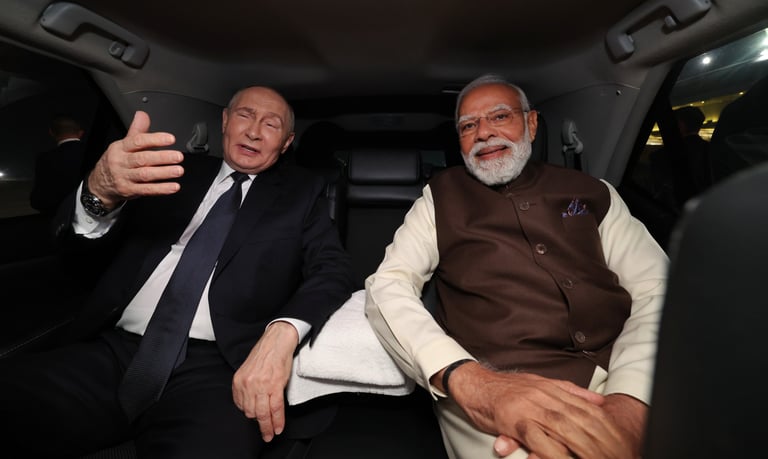
Russian President Vladimir Putin’s state visit to New Delhi on December 4–5, 2025, arrives at a moment when global diplomacy is being reshaped by sanctions regimes, shifting allegiances, and renewed attempts by major Western powers to influence India’s decision-making. Marking 25 years of the India–Russia strategic partnership, the visit underscores the resilience of a relationship that predates current geopolitical tensions and extends beyond transactional exchanges. Prime Minister Narendra Modi’s unusual gesture of receiving Putin at the tarmac signaled not only warmth but also an unambiguous declaration that India’s foreign policy will continue to be guided by sovereign judgment rather than the expectations of self-absorbed agenda-driven Western players, far removed from India’s realities, who assume the world must orbit around their interests.
India’s strategic partnership with Russia has endured because it is grounded in reliability and shared strategic outlooks. Moscow has supplied the majority of India’s military inventory for decades and has consistently demonstrated willingness to transfer sensitive technologies that Western nations often hesitate to share. Current discussions on additional S-400 batteries, enhanced cooperation on nuclear submarines, Su-30MKI upgrades, and expansion of the BrahMos missile joint venture reflect India’s recognition that its defense modernization cannot depend on external conditions that change with every election cycle and the whims of foreign leaderships. Russia’s openness to India’s potential interest in the Su-57 platform further illustrates a technological relationship that remains difficult to replicate elsewhere, particularly as Washington continues to rule out F-35 access and delays commitments such as GE engine deliveries.
Further, the Western reaction to President Putin’s visit laid bare a widening disconnect between India’s strategic autonomy and Europe’s presumptive expectations. The joint op-ed by the British, French, and German ambassadors, released at a moment of heightened geopolitical tension is being viewed in New Delhi as an undiplomatic attempt to pressure India’s sovereign decisions and interfere in its bilateral relations with a third country. India’s firm response underscored that such public admonitions violate basic diplomatic norms, especially when European nations themselves continue to buy Russian energy through indirect routes and possess long history of arms exports to conflict zones all over the world.
Already, complicating these dynamics further has been the inconsistent and, at times, contradictory approach of the United States under Donald Trump. Though Washington remains an essential partner for India, Trump’s repeated claims—without evidence—that he personally “stopped a war between India and Pakistan” reveal a tendency to point to a recurring effort to plant himself at the center of regional developments for leverage in trade matters. His meetings immediately after the Indo-Pak conflict with Pakistan Army Chief Asim Munir and Prime Minister Shehbaz Sharif, coupled with flattering remarks toward Islamabad, have caused quite unease in New Delhi. Moreover, his public dismissal of India as a “dead economy,” widely viewed as disrespectful to 1.4 billion Indians, has reinforced the perception of an unreliable and at times condescending approach to India.
These diplomatic inconsistencies have been matched by policy decisions that directly impact Indian interests. Trump-era immigration restrictions have hindered the mobility of Indian students, entrepreneurs, and skilled professionals. The prolonged delays in delivering the GE-F414 engines—critical for India’s indigenous fighter programs—stand in contrast to the U.S. administration’s rhetoric about deepening strategic cooperation. While Washington frequently emphasizes the importance of India in the Indo-Pacific, its reluctance to operationalize high-end defense technology sharing sends a conflicting message. These contradictions strengthen India’s conviction that strategic autonomy is essential, not optional.
In contrast, India’s continued engagement with Russia emerges not as defiance but as pragmatic statecraft. Modi’s now-famous statement to Putin—“this is not the time for war”—immediately after Russia’s strikes on Ukraine, and arguing that dialogue, de-escalation, and respect for the UN Charter are the only viable paths to peace, reflects India’s principled stance on conflict resolution, but it has not prevented New Delhi from pursuing cooperation where its core interests are involved. Ongoing discussions on a 2030 economic roadmap, expanded energy partnerships, and the possibility of a Free Trade Agreement with the Eurasian Economic Union represent India’s broader effort to diversify economic and strategic linkages. Russia, for its part, remains one of the few major powers willing to collaborate with India across nuclear energy, hydrocarbons, space technology, and advanced military systems without imposing political conditionalities.
India’s approach is also shaped by the recognition that the global order is becoming less predictable, making diversified partnerships essential. The turmoil in West Asia, Europe’s energy vulnerabilities, and America’s internal political oscillations have all contributed to a world in which no single power bloc can be expected to deliver stability alone. For India, maintaining robust ties with all major powers—Russia, the U.S., Europe, and emerging players in East Asia—is not a diplomatic luxury but a strategic necessity. The ability to navigate competing expectations without alienating any partner is what distinguishes India’s foreign policy in an era when alignment pressures are intensifying.
Ultimately, Putin’s presence in New Delhi is a powerful reminder of the historical continuity and strategic utility of the India–Russia relationship. It also highlights India’s refusal to be cornered into choices that undermine its national interests. As Western governments continue to question India’s partnerships and U.S. political rhetoric swings unpredictably, New Delhi’s message remains consistent: it will collaborate widely, listen respectfully, and maintain constructive ties with all stakeholders—but it will not submit its foreign policy to external approval. In an increasingly fragmented world, India’s insistence on defining its own path is not only rational but imperative.