
What the West Gets Wrong About India’s Ties with Russia
It Needs To Re-Evaluate Its India Strategy
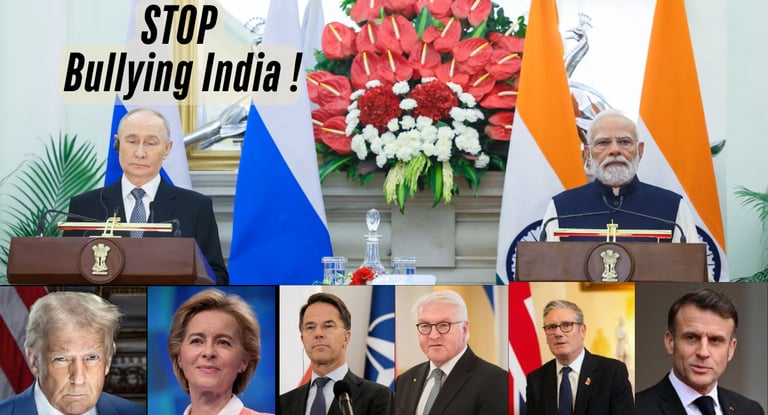
The recent high-stakes summit between Russian President Vladimir Putin and Indian Prime Minister Narendra Modi - resulting in mega-deals on S-400/S-500 systems, offer of co-production of the Su-57 with technology transfer, stable nuclear fuel supply, and a $100 billion trade target via the Rupee-Ruble mechanism - sends an unmistakable signal to the US and the West: Your continuous pressure campaign against India's ties with Russia has failed.
This failure is not a diplomatic accident; it is the entirely predictable outcome of a strategy fatally undermined by the West's own selective morality and high-handed behavior, coupled with a profound misunderstanding of India's non-negotiable strategic priorities and its independent economic direction.
The Double Standards Undermine Call for Russia's Isolation
The greatest hypocrisy undermining the West’s effort to isolate Russia is its own behavior:
Energy Reliance: The US and the EU continue to import Russian enriched uranium for their nuclear power plants, and several EU members still rely on Russian gas and pipeline oil under sanctions exemptions. If the West's strategic energy needs justify purchasing Russian fuel, India's purchase of discounted oil to power its massive, inflation-sensitive economy is an equally valid national interest.
Trade and Self-Interest: The West is pushing India for a quick win against Russia while simultaneously courting New Delhi for massive economic gains. The recent signing of the India-UK Free Trade Agreement (FTA) and the serious, ongoing negotiations for a major FTA with the European Union clearly demonstrate that for London, Paris, and Brussels, India's strategic value outweighs the importance of strict sanctions compliance.
India’s Strategy: Diversification, Not Dependence
India is not putting all its eggs in the Russian basket; it is pursuing a policy of aggressive multi-alignment that maximizes its benefit from every major global power:
Western Economic Integration: The FTAs with the UK and potential EU deal prove India is deeply committed to integrating with Western markets and supply chains.
Western Defence Procurement: India is also a major customer for Western defence equipment, notably buying advanced fighter jets and critical technology from France (e.g., Rafale) and exploring deals with the US.
Rupee-Ruble Mechanism: The renewed focus on the non-dollar Rupee-Ruble trade mechanism with Moscow is a defensive move—a hedge against potential Western sanctions and a step toward internationalizing the Rupee, an ambition that serves India's long-term economic sovereignty, regardless of the partner.
India is not choosing Russia over the West; it is choosing India's national interest over Western demands. It sees Russia as a reliable source of strategic defence and energy technology, and the West as the primary source of advanced trade, investment, and cutting-edge, next-generation military platforms, including crucial high-technology components like microchips and sophisticated unmanned aerial vehicles (UAVs).
What the US and the West Should Focus On
The US and the West must abandon the counterproductive strategy of pressuring India over its Russian ties and instead focus on what truly strengthens their partnership and undercuts Russia's long-term influence:
Offer Better Alternatives, Not Threats: Instead of threatening sanctions over Russian defence equipment, the West must significantly increase the speed, scale, and technology transfer (ToT) offered in its own defence deals with India. If the US and France can offer better, faster, and cheaper access to cutting-edge technology with local production guarantees (Su-57 is the benchmark here), India may naturally gravitate away from Moscow over time.
Support Economic Sovereignty: Actively facilitate the India-EU FTA and boost technology transfer in critical non-defence areas (e.g., semiconductors, clean energy). By supporting India’s rise as an independent manufacturing and technological power, the West deepens the relationship while simultaneously creating a stronger strategic partner against China in Asia-Pacific (though here also, US and EU continue to have strong trade relations with China, but want India to fight China on their behalf – another example of hypocrisy).
Acknowledge Multipolarity: Respect India's strategic autonomy. India is an indispensable partner in the Indo-Pacific—a threat India knows to be existential. The US and the West need India far more in the struggle against Chinese assertiveness than they need India as a compliant tool for isolating Russia.
The call for Russian isolation is a demand for a zero-sum choice. India's answer is a clear affirmation of a multi-aligned world. The West should stop trying to force New Delhi into its orbit and instead focus on becoming a truly indispensable partner through competitive offers, respect for sovereignty, and genuine economic collaboration.
A Call to Action: Partnership Over Pressure
The West must understand that demanding India change its course as per their wishes is a failed strategy. India's definitive answer is a clear affirmation of a multi-aligned world where its strategic autonomy is paramount. To reset this relationship, the US and the EU must immediately take concrete steps: The US must withdraw its high tariffs on Indian goods, the EU must swiftly sign the Free Trade Agreement, and all Western powers must stop lecturing and interfering in India’s sovereign foreign policy matters.
Furthermore, the three Ambassadors in New Delhi must recognize they are guests, not colonial administrators; they must behave as true diplomats and cease all attempts to bully or pressure India on how it manages its bilateral relations with third countries. The West instead needs to focus on becoming a truly indispensable partner through competitive economic offers, unwavering respect for sovereignty, and genuine, non-conditional collaboration.