
Why The World Watches in Silence while a Minority is Erased in “New Bangladesh”
Brutal Reality of Pak-backed Radicalism and West’s Double Standards
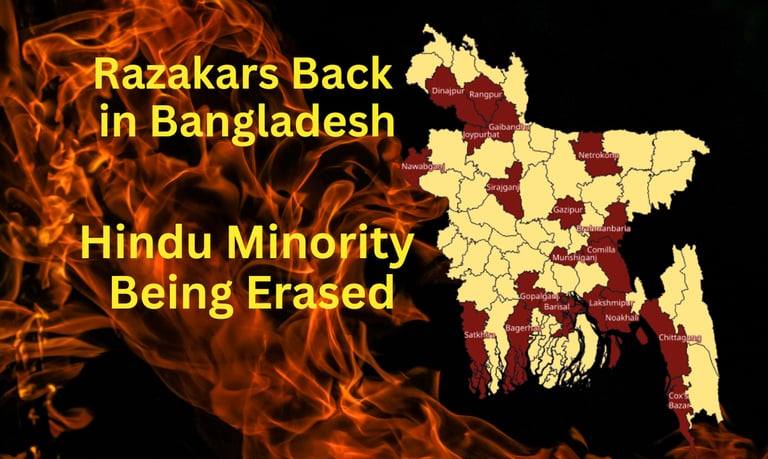
For decades, the story of the Hindu minority in Bangladesh has been one of gradual erasure. But since August 5, 2024—the day Prime Minister Sheikh Hasina fled the country—that erosion has turned into a targeted avalanche of violence. Under the interim government led by Nobel laureate Muhammad Yunus, what was promised as a "new dawn" for democracy has, for many Hindus, become a recurring nightmare of arson, temple desecrations, and brutal lynchings.
The Horror of 18 December 2025: The Case of Dipu Chandra Das
The most recent and ghastly manifestation of this hate occurred on December 18, 2025. In Mymensingh, a 25-year-old garment worker named Dipu Chandra Das was snatched by a mob over baseless allegations of "blasphemy." According to eyewitness reports and harrowing viral videos, Dipu was not just killed; he was beaten, tied to a tree, and set on fire alive in a public spectacle on the Dhaka-Mymensingh highway.
This is not "political instability." It is the barbaric outcome of a climate where minor disputes are weaponized into religious death sentences.
The Architects of Hate: Pakistan’s Influence and the Return of the Jamaat
The ouster of Sheikh Haseena has led to the surge in violence, fueled further by a resurgent Islamist ideology that has been emboldened by rhetoric from across the border and a shift in internal power dynamics.
The "Munir Doctrine": In April 2025, Pakistan’s Army Chief, General Asim Munir, explicitly branded Hinduism as an existential enemy of Islam, stating that Pakistanis are "different from Hindus in every possible aspect... our thoughts are different, our ambitions are different." This revival of the hardline "Two-Nation Theory" provides the ideological fuel for radicals in the region to view Hindu civilians not as fellow citizens, but as "the other" to be purged.
The Rise of Jamaat-e-Islami: With the Awami League ousted, Jamaat-e-Islami and its student wing, Chhatra Shibir, have returned to the center of power. By late 2025, Shibir-backed alliances have swept university elections, entrenching their influence over the youth. These are the same groups whose ideological predecessors collaborated with the Pakistani military in 1971. In a way, the current crisis is a ghost of the past. In 1971, the Pakistani military and local collaborators (the Razakars) unleashed a campaign of mass looting and the systematic rape of hundreds of thousands of women, specifically targeting Hindus. It was this very trauma that fueled the rise of Sheikh Mujibur Rahman and the dream of a secular Bangladesh.
Today, that secular foundation is being dismantled. The burning of Dipu Das and the arrest of Hindu leaders like Chinmoy Krishna Das suggest that the "New Bangladesh" is increasingly hostile to those who refuse to fit the radical Islamist mold.
The Global Double Standard: A Wall of Silence from the West
The most agonizing part of this crisis for the victims is the resounding silence from the international community. Where are the massive marches in London, New York, or Paris? Where are the college campus encampments and the impassioned speeches from the self-proclaimed "champions of free speech and religious tolerance" in the USA and Europe?
While the same West is quick to issue high-decibel condemnations for other conflicts, the systematic lynching of Hindus in Bangladesh is met with a lukewarm "concern" or dismissed as internal political reshuffling. This selective amnesia mirrors the world’s reaction to the 1990 Kashmiri Hindu exodus too. By framing religious persecution as "political retribution," the West avoids its moral obligation to intervene. This double standard exposes a hollow core in global human rights advocacy, where some lives are deemed "protest-worthy" while others are quietly sacrificed at the altar of geopolitical convenience.
Final Thought: Geopolitics Over Humanity
If "Human Rights" are to mean anything, they must be universal. We cannot pick and choose which oppressed communities deserve our empathy. However, the current reality suggests a darker motive for the world's indifference. While the Hindu community is being terrorized, Washington seems preoccupied with seeking strategic control of St. Martin’s Island in the Bay of Bengal - a move reportedly facilitated under the leadership of Muhammad Yunus, an interim head of state widely viewed as West-backed and hand-picked to align with Western interests.
We must remember that the dream of a secular Bangladesh was born out of the ashes of the 1971 genocide, a trauma fueled by the very same rhetoric of "Hinduism as an enemy" that is being recirculated today. And, the "New Bangladesh" will not be a beacon of democracy, but a graveyard for its oldest minority, if the world continues to look away even after a young man like Dipu Chandra Das is burned alive. It is time to demand that the West as also the OIC stop their selective outrage. If you can march for the rights of one, you must have the courage to stand for the rights of all. Silence in the face of the Hindu exodus and killings isn't just a "double standard"—it is a complicity that history will not forget.